



How to Invest for Retirement Without Funding the AI Footprint
First-time homebuyers are facing an uphill battle in today's market. Corporations are increasingly targeting starter homes to generate passive real estate income, viewing them as lucrative investments that offer steady rental income and long-term appreciation potential.
According to Redfin, real estate investors purchased 26.1% of low-priced homes in the U.S. in the last quarter of 2024. That’s the highest percentage of corporate ownership of single-family homes ever recorded. Compared to beginners in real estate investing, these corporate buyers have three significant advantages: deep pockets, access to favorable loan terms, and the ability to outbid other buyers again and again.
All of this has caused the supply of affordable housing options to shrink, driving prices upward. Unfortunately, this trend disproportionately affects younger generations aspiring to own their own homes. The National Association of Realtors reports that the median age of first-time homebuyers in 2024 was 38, up from 29 in 1981.
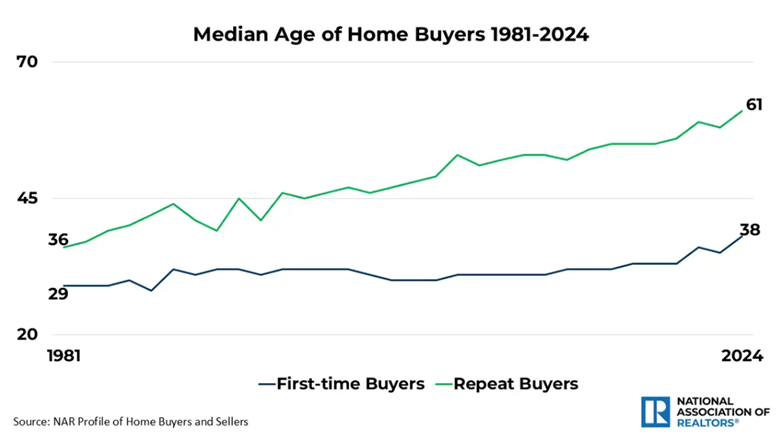
Image source: National Association of Realtors
The Ripple Effect on the Housing Market
Increasing corporate ownership of single-family homes is reshaping the landscape in several ways.
- Reduced supply of homes for sale, which has naturally driven up prices
- Increased difficulty for individuals to compete, especially for first-time buyers
- Growing control over rental properties, leading to potential rent increases
- Economic impact beyond housing, which affects overall financial stability
This shift is making it increasingly difficult for individuals and families to achieve homeownership and build wealth through real estate. So, with all this in mind, many people are researching how to build wealth without buying a home.
Alternatives to Homeownership: How to Build Wealth
While homeownership has traditionally been a foundation of wealth building, it's not the only pathway available. Diversifying investments across various types of assets can help manage risk and grow wealth over time. If you're not ready or able to buy a home, consider these options.
Real Estate Investment Trusts (REITs)
REITs allow investors to participate in the real estate sector through publicly traded stocks rather than purchasing a property outright. It’s a great real estate investment for beginners because these trusts generate income from rents, property sales, and other real estate activities, which can be distributed to investors as dividends.
Additionally, investors may benefit from potential stock price appreciation driven by the REIT’s portfolio performance. REITs provide a hands-off way to invest in real estate while offering liquidity and diversification across various property types. All you have to do is find the best REITs for long-term growth and allow your passive real estate income to grow over time.
Private Real Estate Investment Platforms
Unlike REITs, private real estate investment platforms offer direct opportunities to invest in specific real estate projects or portfolios. Investors can purchase bonds or shares tied to individual developments, such as residential or commercial properties, often at accessible price points.
These investments typically provide fixed returns through interest payments and, in some cases, profit sharing from the underlying projects. Private real estate investment platforms enable more targeted investments in niche opportunities not available in public markets, such as local developments or specialized property types. They also offer a more stable investment vehicle with lower exposure to stock market volatility compared to publicly traded REITs.
Remember: a well-diversified portfolio is a must for long-term financial stability and building generational wealth, especially in challenging environments for primary residence purchases. Sometimes, that means exploring more than one real estate investment for beginners, even real estate crowdfunding for individuals.
Worthy Wealth Housing Bonds
As the housing market becomes increasingly inaccessible, Worthy Wealth’s Housing Bonds are a high-yield, real estate–backed alternative investment designed to provide predictable income outside traditional markets. Proceeds are deployed into residential real estate development, primarily through secured mortgage loans, land acquisition, and infrastructure development in fast-growing Southeastern U.S. markets, with investments typically capped at conservative loan-to-value ratios to mitigate risk. The Worthy Wealth Housing Bonds are accessible, with low minimums, and are insulated from public market volatility, while also investing in the community through funding housing development.
Wrapping Up
In a housing market increasingly dominated by institutional buyers, the path to building wealth is evolving, but it’s far from closed. While homeownership may feel out of reach, today’s investors have more tools than ever to participate in real estate growth without competing directly against corporate giants. From publicly traded REITs to private platforms and income-generating offerings like Worthy Wealth Housing Bonds, alternative investments are helping individuals reclaim access to opportunities that once seemed unattainable. By embracing diversification and thinking beyond traditional ownership, investors can still build meaningful, long-term wealth, even in a market that’s rapidly changing.
